How to make a manga storyboard (name), step by step
Every great manga page you have read was decided before it was drawn. The camera moves, the order of the faces, where the words sit, which moment gets a whole page: all of it is settled in a sketch that takes minutes, so that the drawing, which takes days, never has to be thrown away. This guide shows what that sketch looks like next to a real finished page, and how to make one.
Name, thumbnails, storyboard: what is the difference?
- Thumbnails are tiny pages, a few lines each, that answer one question: where do the big moments fall across the chapter?
- Name (ネーム) is the full rough: panels, rough figures, balloons and the real dialogue, page by page. In Japanese publishing it is the version an editor reads and argues about.
- Storyboard is the English umbrella term. Most searches for a manga storyboard mean the name.
How professionals use it
The name is so central that it can be a separate job. On Death Note and Bakuman, writer Tsugumi Ohba made the storyboards and artist Takeshi Obata drew the pages. In a 2012 interview with VIZ, Ohba said he discusses things with his editor and creates the storyboards, and Obata then “creates his own storyboards” from them before drawing. Two storyboards per chapter, by two people. Rumiko Takahashi’s reported weekly schedule puts the name right after a long meeting with her editor, and gives it about three days, before any final drawing starts.
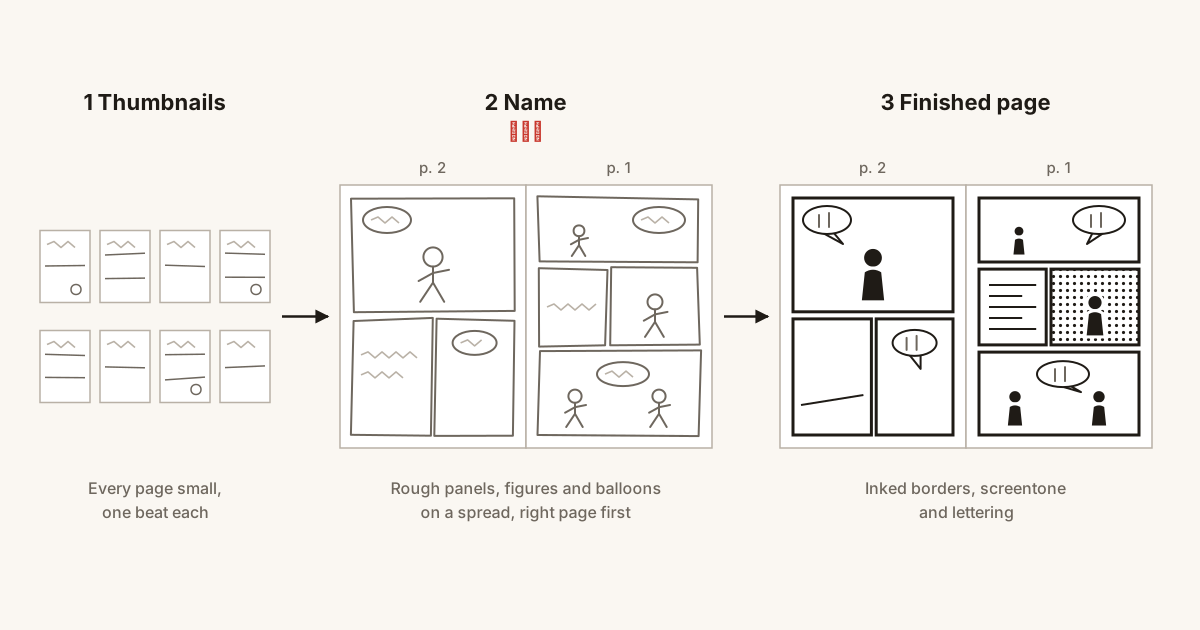
One real page, from name to finish
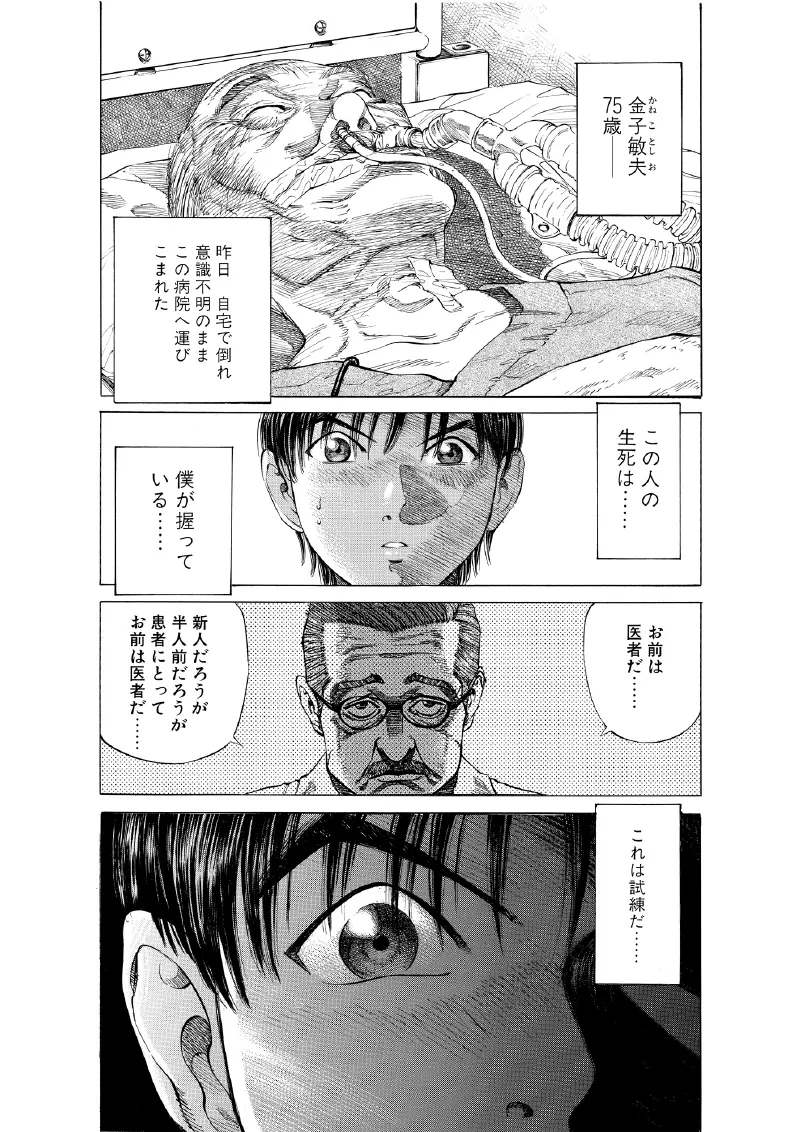
Here is page 83 of Shuho Sato’s Give My Regards to Black Jack. Saitō, a first-year resident, is alone with a patient whose life now depends on him. On the left is our sketch of what a name for this page could look like; on the right, the page as published.
Name (our reconstruction)
Finished page
The sketch would take ten minutes. Yet it already holds every decision that makes the page land, and none of the ones that take days. That is the point of a name: separate the decisions that are cheap to change from the ones that are not, and make the cheap ones first.
What the name decides: the camera
Sato moves the camera in on every tier: the patient, Saitō’s face, a remembered voice, a single eye. Each step tightens the frame and drops words, so the page physically narrows toward the moment Saitō realises what he is facing. That escalation is a storyboard decision. Drawn panel by panel without a plan, it would be easy to repeat the same medium shot four times.
Real manga leans on close shots. Measured across the faces in the Manga109-s dataset:
Camera distance in panels that show a face
This matches research comparing manga with American comics. Neil Cohn and colleagues found manga uses significantly more close-ups, and far more panels showing a single character, while American books spend more panels on wide scenes with several characters. If your name is mostly medium shots of two people talking, that is where to look first.
What the name decides: the page turn
A name is drawn as spreads, not single pages, because the turn is where manga hides its surprises. In a right-to-left book the reader turns after the left-hand page, and the next right-hand page arrives all at once.
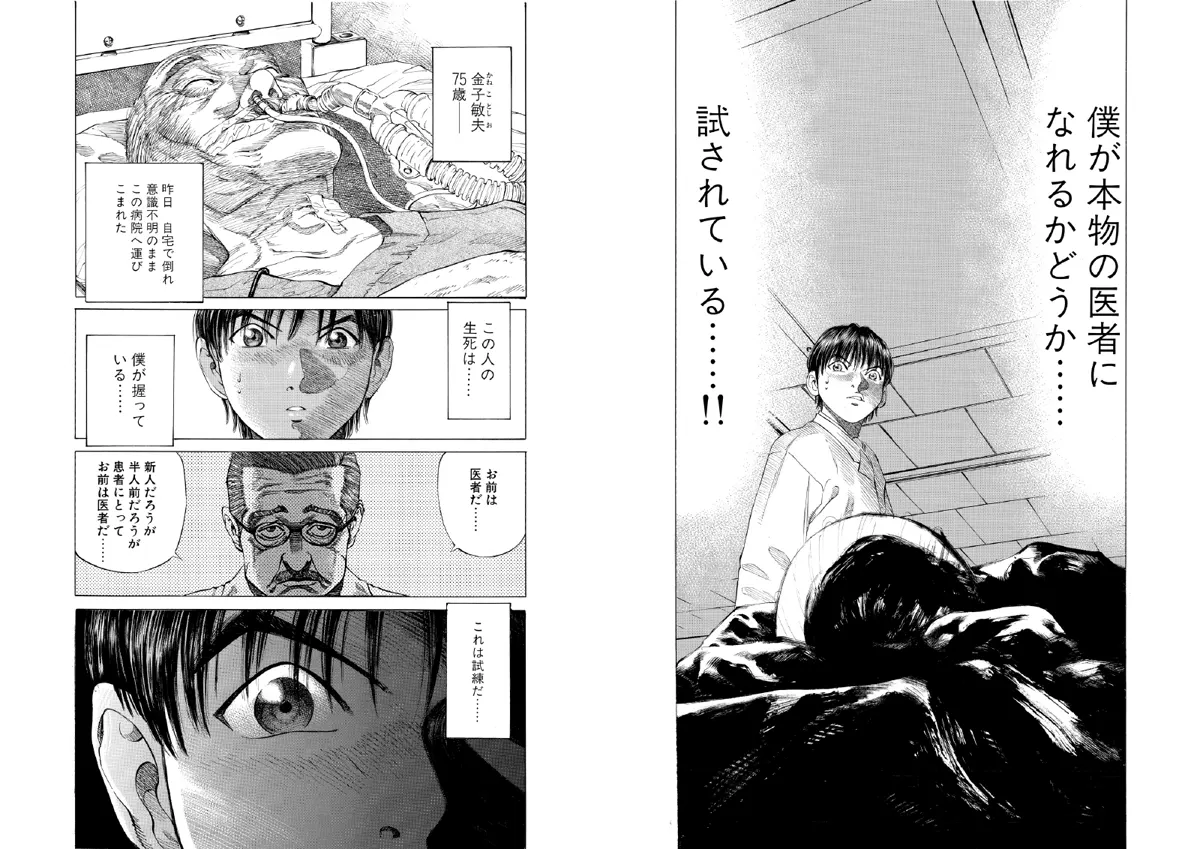
Page 83 is a left-hand page, so its last panel is the one the reader sees with their hand on the corner. Sato puts the eye there, unresolved, and saves the sentence for the full page after the turn. You can only make that choice if you can see both pages at once, which is why a name is planned spread by spread. For more on turns and splash pages, see the panel layout guide.
What the name decides: how much is said
Dialogue goes into the name as real text, not placeholder squiggles, because words take space and time. Published Japanese pages carry less than people expect:
- 8text blocks on a typical page
- 92Japanese characters on a typical page
- 13characters per balloon or caption, on average
Japanese packs more meaning into each character than English does, so do not convert these directly. Use them as a relative check instead: a page with more than 187 characters is wordier than nine published pages out of ten. If a page in your name feels slow, count the balloons before you touch the drawing.
Source: MangaForge’s measurements of the Manga109-s dataset (87 volumes, 15,607 pages, 81,887 panels; Aizawa, Yamasaki and Matsui Laboratory, University of Tokyo), from its panel and text annotations only. The works are courtesy of their authors. Cite: Aizawa et al., “Building a Manga Dataset ‘Manga109’ with Annotations for Multimedia Applications,” IEEE MultiMedia 27(2), 2020.
Make your own name in five passes
Each pass fixes one kind of problem, so you never polish something the next pass would have cut.
- Write one line per page. Before drawing, write what changes on each page in one sentence. Mark the opening hook, every page turn that carries a reveal, the climax and the last-page hook.
- Thumbnail the whole chapter small. Draw every page at stamp size, all on one sheet, as facing spreads. Judge where the big moments fall and check that each reveal lands on a right-hand page after a turn.
- Draw the name spread by spread. Redraw the thumbnails larger as facing pages: panel borders, stick figures, the camera distance of each panel and the reading path. Plan the camera as a sequence, not panel by panel.
- Write the real dialogue in. Letter the actual lines in rough balloons. Check that each page reads in order, that balloons sit at the panel edges rather than over faces, and that no page is crowded with words.
- Read it cold and cut. Put the name away for a day, then read the whole chapter in one sitting. Cut repeated information, repeated camera angles and any panel the story survives without.
How rough is rough enough? Rough enough that redrawing a page costs nothing, clear enough that someone else can read it without you explaining. Faces can be an oval with a line for the eyes. The dialogue has to be the real dialogue.
Pacing mistakes a name should catch
- A reveal before the turn. A reveal on a right-hand page is seen before the reader turns to it, and even one on a left-hand page gets glimpsed early. Hold it for the next right-hand page.
- Four medium shots in a row. Talking heads at the same distance read like a stall. Move the camera in, or out, with a reason.
- A rushed ending. Makers detail the opening and sprint the last two pages. Give the final beat the room you gave the first.
- Crowded pages. Most published pages hold four to seven panels. Past that, with long balloons, the eye slows to a crawl. If you need all of it, split the page.
- A splash with nothing behind it. A full page only lands if the pages before it built toward it. If you cannot point to the build-up, spend the page on something else.
Draw your name in MangaForge
MangaForge is a browser-based manga studio, in beta. Its name view is built for passes 3 and 4 above, and it does not generate images or artwork: the name is drawn by hand.
- One spread at a time. You draw on two facing pages, which is where a name is made.
- A Sheet for the whole chapter. See every spread in rows to judge flow and page turns, and move or insert whole spreads.
- Hand-drawn tools. Pencil and eraser for rough marks, a panel-line tool for cutting panels, and balloons you type real dialogue into.
- Same document as your pages. The name is a view of the chapter, so you move on to panels and final art in the same file.
- Read mode. A full-screen page-flip reader for the cold read in pass 5.
日本語版: ネーム作成ツール
Frequently asked questions
- What is a manga storyboard?
- A rough, page-by-page draft of a chapter showing panel layout, rough figures, real dialogue and page turns. In Japan it is called name (ネーム). It is drawn before the final art so structure can be fixed while changes are cheap.
- What does name (ネーム) mean in manga?
- Name is the Japanese industry term for the manga storyboard: the rough version of every page that a mangaka shows their editor before drawing. The word is written ネーム and pronounced nēmu.
- How detailed should a name be?
- Detailed enough that someone else can follow it without you explaining. Figures can be ovals and sticks, backgrounds a horizon line, but the dialogue should be the real text and the camera distance of each panel should be clear.
- How many thumbnails should I draw per page?
- Usually one, small. If a page will not resolve, try two or three alternatives for that page only, rather than redrawing the whole chapter.
- Is a name the same as a film storyboard?
- They are close cousins. A film storyboard plans shots in time; a name plans printed pages, so panel size, page turns and where the words sit matter as much as the shot.
- How much dialogue fits on a manga page?
- In the Manga109-s dataset a typical Japanese page carries about 8 text blocks and 92 characters, and nine pages in ten carry fewer than about 190. Use this as a relative check rather than a word count for English.
Sources
- Shuho Sato, Give My Regards to Black Jack vol. 1, free secondary-use edition
- VIZ Media, interview with Tsugumi Ohba, 2012
- SoraNews24, Rumiko Takahashi’s weekly schedule, 2021
- Cohn, Taylor-Weiner and Grossman, “Framing Attention in Japanese and American Comics,” Frontiers in Psychology 3:349, 2012
- Manga109-s dataset, Aizawa, Yamasaki and Matsui Laboratory, University of Tokyo. Statistics measured by MangaForge from the annotations; no images used
MangaForge is in beta. Already have an account? Sign in.