Manga page size: B4, B5 and A5 in mm, inches and pixels
Search for “manga page size” and you get five different answers. Most of them are right, for a different job. A contest manuscript, a doujinshi, a tankobon on a shelf and a webtoon on a phone are four different objects, and the numbers only make sense once you know which one you are making. This guide sorts them out, converts everything to pixels and inches, and shows what the margins look like on a real published page.
Pick your size by what you are making
| If you are… | Page size | File |
|---|---|---|
| Entering a Japanese contest or pitching a magazine | B4 manuscript, 180 × 270 mm basic frame | 600 dpi or more, black-and-white (1-bit), PSD or TIFF |
| Printing a doujinshi | B5 (182 × 257 mm) or A5 (148 × 210 mm), plus 3 mm bleed | 600 dpi for monochrome pages, 350 dpi for colour covers |
| An English print edition | Often 5 × 7.5 in (127 × 190.5 mm) trim, set by the publisher | Ask for the template; 5 × 7.5 in at 600 dpi is 3,000 × 4,500 px |
| Webtoon (vertical scroll) | Width in pixels; no paper size at all | WEBTOON Canvas takes images up to 800 × 1280 px each |
If you are drawing for yourself and are not sure yet, start on the first row. A B4-class canvas with a 180 × 270 mm frame shrinks cleanly to every smaller print format, while a small canvas cannot grow without losing detail.
Four rectangles: canvas, bleed, trim and frame
Almost every print problem comes from mixing up these four.
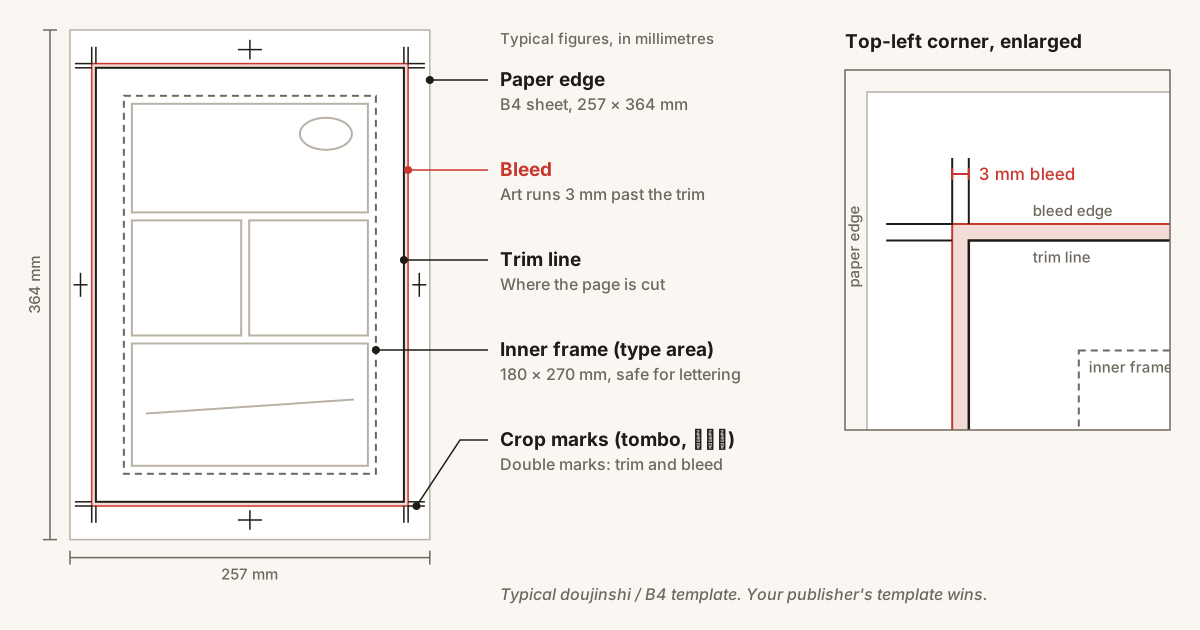
- Trim is the finished page, where the guillotine cuts. It is what the reader holds.
- Bleed is the extra strip outside the trim, usually 3 mm (some printers take 5 mm). Cutting is never perfectly exact, so any art meant to touch the edge has to continue into the bleed.
- Canvas is the file you draw on: trim plus bleed on all four sides. A 182 × 257 mm B5 page with 3 mm bleed is a 188 × 263 mm canvas.
- Inner frame (内枠, also basic frame or type area) is the rectangle where panels and lettering live. It keeps them clear of the cut and the binding.
What it looks like on a published page
Here is a page from Shuho Sato’s Give My Regards to Black Jack (ブラックジャックによろしく), a medical drama about a first-year resident. Look at where the panel borders stop, and at the one panel that refuses to.
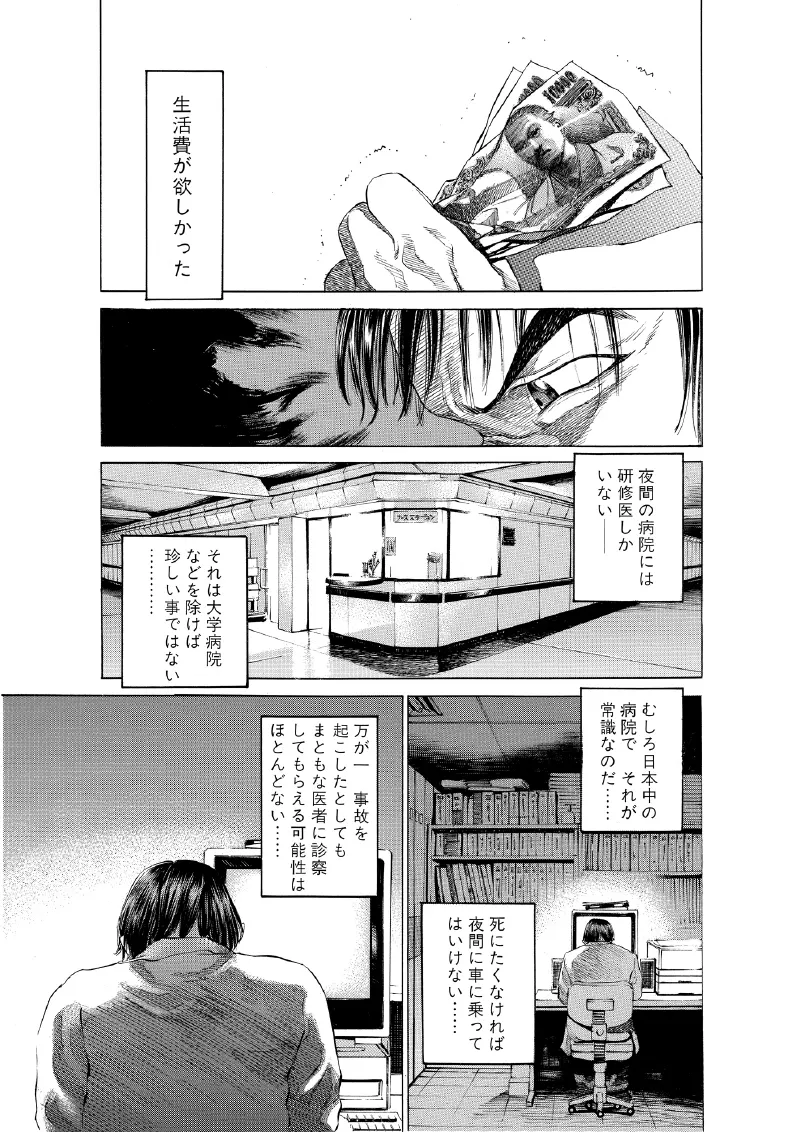
Two habits are visible. Every framed panel stops on the same two lines, so the page edge feels calm even when the content is not. And the one bleed panel runs off the outer edge. This is a left-hand page, so its spine is on the right; art that bled into the spine would vanish into the binding.
Every size in mm, inches and pixels
Pixels depend on resolution, so each size is given at the two resolutions you will meet most: 600 dpi for black-and-white pages and 350 dpi for greyscale or colour. Use the row with bleed when your art runs to the edge.
| Size | mm | inches | px at 600 dpi | px at 350 dpi |
|---|---|---|---|---|
| B4 manuscript sheet | 257 × 364 | 10.12 × 14.33 | 6,071 × 8,598 | 3,541 × 5,016 |
| Basic frame (内枠) on B4 | 180 × 270 | 7.09 × 10.63 | 4,252 × 6,378 | 2,480 × 3,720 |
| B5 | 182 × 257 | 7.17 × 10.12 | 4,299 × 6,071 | 2,508 × 3,541 |
| B5 + 3 mm bleed | 188 × 263 | 7.40 × 10.35 | 4,441 × 6,213 | 2,591 × 3,624 |
| A5 | 148 × 210 | 5.83 × 8.27 | 3,496 × 4,961 | 2,039 × 2,894 |
| A5 + 3 mm bleed | 154 × 216 | 6.06 × 8.50 | 3,638 × 5,102 | 2,122 × 2,976 |
| B6 tankobon | 128 × 182 | 5.04 × 7.17 | 3,024 × 4,299 | 1,764 × 2,508 |
| Shinsho tankobon (新書判) | 112 × 176 | 4.41 × 6.93 | 2,646 × 4,157 | 1,543 × 2,425 |
The arithmetic, if you need a size that is not listed: pixels = mm ÷ 25.4 × dpi. A 3 mm bleed adds 6 mm to each dimension, because it goes on both sides. At 600 dpi, that is about 142 px.
What publishers actually ask for
These come straight from the submission rules of Japan’s three biggest manga publishers. Notice what they agree on (a 180 × 270 mm frame, 600 dpi, black and white) and what they leave open (the exact sheet size).
| Publisher and contest | Paper | Frame | Digital file |
|---|---|---|---|
| Shueisha · Jump Rookie U23 award | 230–260 × 330–365 mm | 180 × 270 mm | JPG or PNG in a ZIP, up to 200 MB |
| Shueisha · Jump+ award | A4 or B4 | not stated | 600 dpi+ monochrome, 350 dpi+ colour |
| Kodansha · Magazine New Artist award | B4 | not stated | 600 dpi+, 1-bit, TIFF preferred |
| Shogakukan · Shin-Comic award | 230–260 × 330–370 mm | 180 × 270 mm | B4 actual size, 600 dpi+, 1-bit, TIFF or PSD |
Jump Rookie also advises keeping faces and lettering 8–10 mm inside the finished edge. That is a safer rule of thumb than any single trim number, because it works whatever the final book size turns out to be.
Why 600 dpi, and why black and white
A printed manga page is mostly pure black ink on white paper. Grey does not exist: screentone is a pattern of black dots small enough that your eye averages them into grey. That is why publishers ask for 1-bit files, where every pixel is either black or white, and why they need 600 dpi. At lower resolutions the dots of a screentone start to merge or clash with the printer’s own grid, and you get muddy tones and moiré.
The bit depth also decides how heavy your files are. One B4 sheet at 600 dpi is 52 million pixels:
- 6.5 MB1-bit black and white, uncompressed
- 52 MB8-bit greyscale
- 157 MBRGB colour, before layers
Multiply by layers and by 30 pages and you see why people draw in greyscale and convert to 1-bit only at export. Test your device on one full page before committing to a chapter.
Drawing big, printing small
A magazine manuscript is drawn larger than any book it ends up in, and then reduced. Everything shrinks with it, including your line weights and your lettering. Plan for the smallest edition, not the one you draw at:
| Drawn at | Printed at 80% | Printed at 70% | Printed at 60% |
|---|---|---|---|
| 0.5 mm line | 0.40 mm | 0.35 mm | 0.30 mm |
| 0.1 mm hatch line | 0.08 mm | 0.07 mm | 0.06 mm |
| 4 mm lettering | 3.2 mm | 2.8 mm | 2.4 mm |
A hatch line that looked crisp at full size can disappear at 60%. If a detail matters, check it zoomed out to the print size, not zoomed in.
Webtoon and screen sizes
A webtoon has no trim, no bleed and no dpi that matters, only pixel width. WEBTOON’s Canvas uploader accepts images up to 800 × 1280 px each and slices anything larger. Drawing at double width (1600 px) and scaling down at export keeps lines sharp. Screen pages for vertical scroll are a different format entirely; for print-style pages read on screen, the panel layout guide still applies.
Where the numbers disagree
Most guides print one table and stop. These are the places where honest sources give different answers, and what to do about each.
“The trim is 220 × 310 mm”
You will see 220 × 310 mm quoted as the standard trim for a B4 manuscript, and drawing apps ship it as a preset (so does MangaForge). We could not find it in any publisher’s public submission rules. Shueisha and Shogakukan publish a paper range and the 180 × 270 mm frame, and leave the trim to their own templates. Treat 220 × 310 as a sensible working value, not a rule.
3 mm or 5 mm of bleed
Most Japanese doujinshi printers ask for 3 mm; some accept 5 mm, and Clip Studio Paint offers both. More bleed never hurts the print, it only costs a little drawing. If you do not know the printer yet, use 5 mm and crop later.
Shinsho is 112 × 174 or 112 × 176
Both figures circulate for the shinsho format used by Jump Comics and many shonen volumes. Printers’ tables list 112 × 176 mm. Two millimetres will never matter for your drawing, only for a print order, and the printer will tell you.
dpi is a recommendation, not a law
Every publisher above words it as “600 dpi or more” or “recommended.” Some doujinshi printers take 1200 dpi for line art. Going higher costs file size; going lower costs screentone quality. 600 is the floor most people agree on for black and white.
A4 versus B4
Japanese manga paper is B4, the same B series as the B5 magazines and B6 books it ends up in. Outside Japan, A4 is easier to buy and scan, and Jump+ accepts it. The frame, not the sheet, is what has to match: 180 × 270 mm fits on A4 (210 × 297 mm) with room for the margins.
Common mistakes
- Lettering near the edge. Text close to the trim can be cut or swallowed by the binding. Keep dialogue and sound effects inside the inner frame, ideally 8–10 mm from the finished edge.
- Stopping bleed art at the trim line. A panel that ends exactly at the trim risks a white sliver after cutting. Extend it to the canvas edge.
- Bleeding into the spine. Bleed off the outer edge, top or bottom. Art that runs into the binding side disappears into the fold.
- Upscaling a small canvas. Drawing at 72 or 150 dpi and enlarging later does not recover detail. Lines go soft and tones go muddy.
- Mixing millimetres and pixels. Print templates are in mm and screen files are in px. Convert once, at a stated dpi, and write it down.
Once the page is set up, the next decisions are what goes inside the frame: see manga panel layout for how many panels to use and how wide to make the gutters, measured across 15,607 real pages.
Set it up in MangaForge
MangaForge is a browser-based manga studio, in beta. It does not generate artwork; you draw every page yourself. Its page setup follows the canvas, bleed, trim and frame model above.
- Presets. The New page dialog groups presets as Paper (A4, A5, B4, B5, B6), Commercial manuscript (trim 220 × 310 mm, inner frame 180 × 270 mm, bleed 3 or 5 mm), Doujinshi (B5 and A5), Publisher, and Screen / webtoon (sized in pixels).
- Bleed and resolution. Print presets offer 3 or 5 mm of bleed and 350 or 600 dpi. The canvas is computed as trim plus bleed on every side.
- Guides. A print guides toggle draws the bleed, trim, inner frame and safe line on the page.
- Export. Print export gives the whole canvas with bleed, the trim only, or the canvas with Japanese-style crop marks.
If your publisher gave you a template, type its trim, bleed and frame into Page setup instead of using a preset. Next, plan the pages themselves with the manga storyboard guide.
Frequently asked questions
- What size is a standard manga page?
- There is no single standard. Japanese magazine manuscripts are drawn on B4 paper (257 × 364 mm) with panels inside a 180 × 270 mm frame. Doujinshi are usually B5 (182 × 257 mm) or A5 (148 × 210 mm), and collected volumes are printed smaller, at B6 (128 × 182 mm) or shinsho (112 × 176 mm).
- What size is manga paper?
- Japanese manga manuscript paper is B4 class. Shueisha and Shogakukan accept sheets from about 230–260 mm wide and 330–370 mm tall, with a printed 180 × 270 mm basic frame. A4 also works, since the frame fits on it.
- What is the manga canvas size in pixels?
- At 600 dpi, a full B4 sheet is 6,071 × 8,598 px and the 180 × 270 mm frame is 4,252 × 6,378 px. A B5 doujinshi page with 3 mm bleed is 4,441 × 6,213 px, and an A5 page with bleed is 3,638 × 5,102 px.
- What resolution should manga pages be?
- Publishers ask for 600 dpi or more for black-and-white (1-bit) pages and 350 dpi or more for colour. These are minimum recommendations; some printers take 1200 dpi line art.
- How big is a manga page in inches?
- A B4 manuscript sheet is 10.12 × 14.33 in, and its frame is 7.09 × 10.63 in. A Japanese B6 tankobon is 5.04 × 7.17 in, and many English editions are 5 × 7.5 in.
- How much bleed does manga need?
- Most printers ask for 3 mm on every side; some accept or prefer 5 mm. Art that should touch the page edge has to extend all the way to the edge of the bleed.
- What size should a manga panel be?
- Panels are not a fixed size. Across 15,607 pages of the Manga109-s dataset, a page usually holds 4 to 7 panels and the largest panel takes about a third of the frame. See the manga panel layout guide for the full measurements.
Sources
- Shueisha, Jump Rookie U23 award rules
- Shueisha, Shonen Jump+ award rules
- Kodansha, Weekly Shonen Magazine new artist award
- Shogakukan, Shin-Comic award rules
- Neko no Shippo, digital manuscript guide (sizes, bleed, dpi)
- Clip Studio Paint manual, creating a new canvas
- WEBTOON Canvas upload limits
- VIZ Media product pages (5 × 7.5 in trim)
- Shuho Sato, Give My Regards to Black Jack vol. 1, free secondary-use edition
MangaForge is in beta. Already have an account? Sign in.